Can a Chiropractor Help with TMJ? Understanding the Jaw-Neck Connection
Chiropractic care may help some cases of TMJ disorder when jaw symptoms are connected to tension or restriction in the upper cervical spine, though it isn’t a treatment for every cause of jaw pain. A thorough evaluation of both the jaw and neck is typically needed to determine whether that connection applies to your specific symptoms.
Your jaw clicks every time you open it wide, and lately it’s started aching by the end of the day — right around the same time a dull headache creeps in near your temple. You’ve tried a mouthguard, maybe even seen a dentist about it, but the ache hasn’t fully gone away. What’s easy to miss is that jaw symptoms don’t always start in the jaw. For some patients, a closer look at the neck is part of the picture.
What Is TMJ Disorder, and What Does It Actually Involve?
The temporomandibular joint is the hinge connecting your jawbone to your skull, used every time you talk, chew, or yawn. TMJ disorder can show up as jaw pain or tenderness, a clicking or popping sound when opening the mouth, difficulty chewing, occasional jaw locking, facial pain, or headaches that seem to originate near the ear or temple. It’s commonly linked to teeth grinding, jaw clenching from stress, a direct injury to the jaw, or arthritis in the joint itself. Traditional treatment usually starts with a dentist — mouthguards, physical therapy, or in more involved cases, surgical evaluation.
For many people, symptoms come and go depending on stress levels, jaw use, or how consistently a nightguard is worn. That variability is part of what makes TMJ frustrating to manage on your own — a mostly quiet week can be followed by several days where chewing anything firm becomes genuinely uncomfortable, without an obvious trigger for the change.
Why Might a Chiropractor Look at Your Neck for a Jaw Problem?
The muscles that control jaw movement work closely with muscles in the upper neck, and the trigeminal nerve, which governs sensation in the jaw and face, has real anatomical connections to the upper cervical spine. When the top two vertebrae are misaligned, the resulting muscle tension can radiate forward into the jaw, creating or worsening symptoms that look exactly like a purely dental TMJ problem. A common pattern is a patient who has already tried a mouthguard or dental treatment without full relief, only to find that persistent upper-neck tension was part of what kept symptoms from fully resolving.
This isn’t a claim that neck involvement explains every case, or even most cases. It’s one contributing factor worth ruling in or out, and doing that starts with an exam that looks at the jaw and neck together, rather than treating them as two unrelated complaints that happen to show up in the same patient.
Does This Mean Every Jaw Problem Is Actually a Neck Problem?
Not at all — this is a common misconception worth addressing directly. Most TMJ cases are primarily dental or muscular in origin, and a cervical connection is one possible contributing factor, not a universal explanation. Two patients can describe nearly identical jaw symptoms while having very different underlying findings on examination. What matters is determining what’s actually contributing to your particular case rather than assuming one explanation fits everyone.
This is exactly why a combined jaw-and-neck evaluation isn’t about assuming the most complicated explanation. It’s about not ruling out a real, fairly common contributing factor just because the primary complaint happens to be in the jaw rather than the neck.
What a Chiropractic Evaluation for Jaw-Related Symptoms Involves
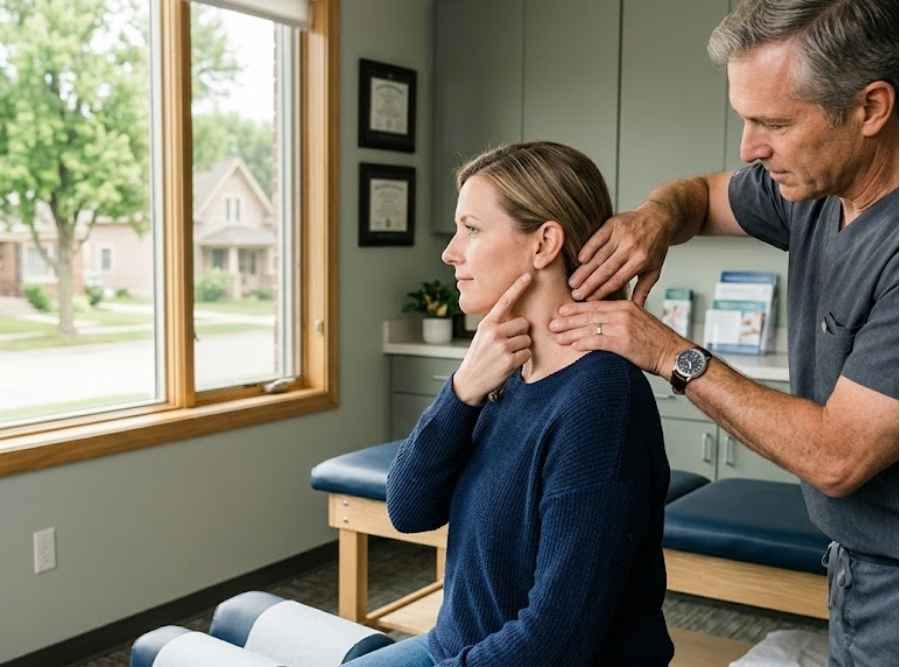
At Genesis Chiropractic, a Gonstead-based evaluation for jaw symptoms includes patient history, a full-spine X-ray with particular attention to the upper cervical spine, and motion palpation to check for restriction or misalignment in that area. Dr. Alex or Dr. Maycee will ask about your jaw symptoms alongside your neck history, since the two are often connected even when a patient doesn’t think to mention both. If a cervical component is identified, a specific adjustment targets that finding directly, rather than treating the whole spine the same way regardless of what the exam shows.
If jaw locking is severe, accompanied by significant swelling, fever, or follows a recent injury to the face or jaw, that combination warrants prompt medical evaluation rather than starting with chiropractic care.
Is It Time to Have Your Neck Checked Too?
If jaw symptoms have persisted despite dental treatment, or you’ve noticed neck stiffness alongside jaw pain, an evaluation of both areas can help clarify what’s contributing to it. Genesis Chiropractic provides individualized Gonstead chiropractic care in Appleton, and our team can help determine whether the cervical spine is playing a role in your symptoms.
Frequently Asked Questions
Can a chiropractor actually help with TMJ pain?
For some patients, yes, particularly when a cervical spine misalignment is contributing to jaw muscle tension. It works best alongside dental care for TMJ, not as a replacement for it.
Should I see a dentist or a chiropractor first for jaw pain?
Starting with a dentist is reasonable, since dental causes are the most common source of TMJ symptoms. If symptoms persist despite dental treatment, a chiropractic evaluation of the neck is a reasonable next step.
Will I need X-rays for a jaw-related evaluation?
At Genesis Chiropractic, a full-spine X-ray with attention to the upper cervical spine is typically part of the initial evaluation, since it helps identify whether a neck-related factor is contributing to your symptoms.

Dr. Alex and Dr. Maycee Sturino are the chiropractors at Genesis Chiropractic, a Gonstead-specific clinic in Appleton, Wisconsin serving patients throughout the Fox Cities. They use full-spine X-rays and hands-on analysis to pinpoint the exact source of a patient’s pain before making a precise, individualized adjustment. Dr. Alex is a U.S. Army veteran who served as a medic in the 82nd Airborne, and Dr. Maycee is Webster Certified through the ICPA for prenatal chiropractic care — together bringing a specific, patient-centered approach to every exam.